The Luo Lab studies epigenetic and metabolic alterations through crosstalk with hypoxia in cancer development with the goal of identifying vulnerability to treat human cancers, particularly breast cancer, kidney cancer, and brain tumors. We utilize in vitro and in vivo models including genetic mouse models, patient-derived xenograft models, and organoid models in our studies. Currently, our research is supported by grants from NIH, DoD, CPRIT, and private foundations.
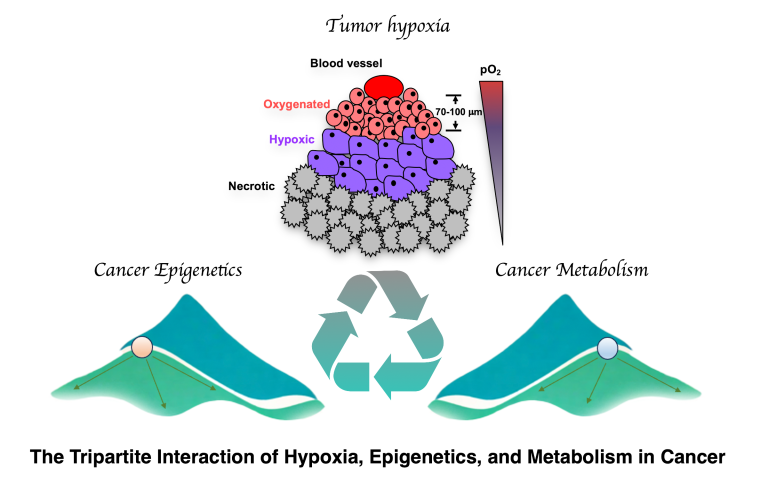
We are investigating how hypoxia promotes cancer progression and metastasis and how hypoxia can be hijacked to treat cancers.
1. We identified HIF coactivators and defined their roles in cancer progression and metastasis (Chen Y. et al., J Clin Invest. 2018; Bao L, et al., Nucleic Acids Res 2018; Wang Y. et al., Cancer Res 2020). These findings reveal multiple layers of regulation that shape HIF transcriptional activity in cancer. We also characterized the landscape of HIF-induced non-coding RNAs in breast cancer cells and defined their roles in breast cancer progression and metastasis (Niu Y. et al., Cancer Res 2020; Chen L, Bao L, et al., Mol Cancer Res 2021). These findings provide the clear evidence that long non-coding RNAs constitute an additional layer of hypoxia-responsive gene regulation, expanding the complexity and diversity of mechanisms governed by HIF signaling.
2. We recently initiated HIF-focused translational studies and uncovered a cell death-priming role of HIF in VHL-deficient ccRCC. Our chemical screens led to the development of an epigenetic strategy that exploits this HIF-dependent vulnerability to selectively eliminate VHL-deficient ccRCC cells in preclinical models (Wang Y et al., Cell Rep Med 2026). These findings introduce an innovative and fundamental concept that may open a new trajectory of research at the intersection of tumor hypoxia and cancer therapy.
We generated Zmynd8 knockout mouse models and showed that ZMYND8 promotes breast cancer plasticity and tumor initiation in mice by inducing 27-hydroxycholesterol and suppressing ferroptosis (Luo M, et al., Sci Adv. 2022; Luo M, et al., J Clin Invest 2024). We also defined a role of ZMYND8 in anti-HER2 therapy resistance in HER2+ breast cancer and showed that ZMYND8 reprograms phospholipid metabolism and inflammatory signaling to promote HER2 antibody resistance in preclinical models (Wang Y et al., Nat Commun 2025). These studies suggest that targeting ZMYND8 is a promising strategy for the treatment of breast cancer. We are currently investigating the physiological role of ZMYND8.
We are actively investigating how BCAA metabolism is regulated in cancers and BCAA-dependency in cancers. Please refer to our recent publications for details (Zhang B, Chen Y, et al. Cell Mol Life Sci 2021; Peng H et al. Oncogene 2020; Zhang B, Peng H, et al., Cancer Res 2022).
We focused on transcriptional corepressors, a class of chromatin-associated regulators traditionally viewed as gene-silencing factors. However, their context-specific roles in cancer development remain poorly defined. Specifically, we showed that RCOR2 acts as a dual transcriptional corepressor of CIITA/MHC-II and WNT signaling, thereby suppressing cytotoxic T cell infiltration and activation and increasing cancer stemness, both of which promote tumor development (Bao L et al., J Clin Invest 2025). These findings reveal a "two birds with one stone" effect for RCOR2 in cancer and establish a valuable framework for simultaneously targeting tumor cell plasticity and immunogenicity to improve the treatment of human cancers. We also identified a previously unrecognized transcriptional coactivator function of the transcriptional corepressor SAP30, which recruits MLL1 to remodel chromatin and promote breast cancer progression (Bao L et al., J Clin Invest 2023). These findings reveal SAP30 as a transcriptional dependency in breast cancer and suggest new therapeutic opportunities for this malignancy.