Mind to Motion
We are a multidisciplinary and collaborative research group that thinks outside the box to create intuitive and wearable brain-machine interfaces.
Our values: We teach anyone who is willing to learn, translate our findings into societally relevant applications, promote (multidisciplinary) teamwork, and strive for open and collaborative science.
We are always looking for motivated students, researchers and participants!
Principal Investigator

Ceci Verbaarschot, Ph.D.
Ceci is an Assistant Professor of Neurological Surgery at the University of Texas-Southwestern in Dallas, with secondary appointments at the Biomedical Engineering Department and the Peter O’Donnell Jr. Brain Institute. Being from the Netherlands, she completed her Bachelors in Artificial Intelligence, Masters in Cognitive Science and Ph.D. in Brain-Computer Interfacing at the Radboud University in Nijmegen (the Netherlands). With her interdisciplinary expertise in artificial intelligence, neuroscience, psychology and philosophy, she develops intuitive intracortical brain-computer interfaces that can assist, restore, or enhance a person’s sensory and movement capabilities. To do so, she makes use of implanted microelectrode arrays that can both record from and stimulate the brain. Her scientific contributions have been awarded with a third place win of the Annual BCI Award (2023), as well as a first place win in the BCI Race of the international Cybathlon competition (2024) – the Olympics for assistive technology in Switzerland.
With a passion for consciousness and movement, Dr. Verbaarschot spent her early career on defining the relation between the experience of an intention to move and the neural preparation for movement (Verbaarschot et al., 2015, 2016, 2018, 2019). She brought her research into practice at the University of Pittsburgh (supported by a Rubicon grant from the Dutch Research council). There, she developed a novel interface with which three participants with tetraplegia designed their own sensations by manipulating various parameters of intracortical brain stimulation. In response, participants described object-specific and intuitive sensations reminding them of the warm fur of a purring cat, or the cool smooth surface of an apple (Verbaarschot et al., in press.). For this work, she has received a Trainee Professional Development Award from the Society for Neuroscience (2021) and was invited to talk at the Zuckerman Institute of Columbia University (2023).
Dr. Verbaarschot specializes in creating bidirectional BCIs; interfaces that can read from and write to the brain. For example, to investigate the neural communication between somatosensory and motor cortex, she developed a Guitar Hero-like game that enabled participants to ‘play’ the strings via imagined finger movements and ‘feel’ what string they play via intracortical microrecordings and -stimulation, respectively, of their brain (which was selected for a Trainee Spotlight presentation at the international BCI Society conference, 2022).
In addition to her scientific achievements, Dr. Verbaarschot teaches with great enthusiasm and has received her Dutch University Teaching Qualification in 2021. On a voluntary basis, she has also taken an active role in organizing and conducting public outreach projects. For example, teaching a Python course for beginners and organizing various demonstrations and educational experiments during public events with both kids and adults.
Current lab members
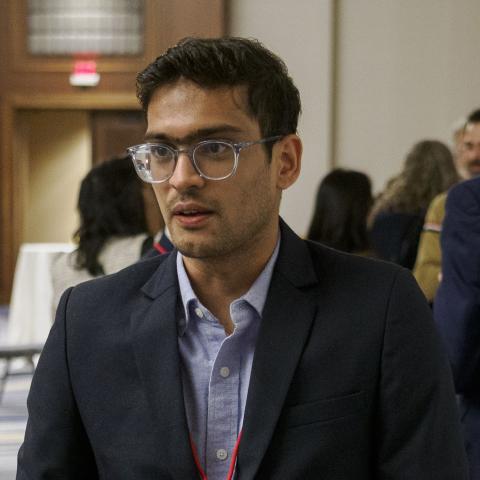
Rohit Rangwani, Ph.D.
Rohit received his Bachelor’s degree in Electronics and Communication Engineering from the National Institute of Technology (NIT), Warangal, India, and his Master’s degree in Electrical and Computer Engineering from Texas A&M University, College Station, TX. During his undergraduate studies, he worked on a motor imagery-based brain computer interfaces (BCIs) using a commercially available EEG device. For his master’s research, he focused on sensory modulation and augmentation to alter proprioception through transcutaneous electrical stimulation.
Recently, Rohit completed his Ph.D. in Bioengineering (Neuroengineering) at the University of California, Los Angeles (UCLA), where he validated cerebellar-driven brain-machine interfaces (BMI) in rodent stroke models as a visiting graduate student at Cedars-Sinai Medical Center, Los Angeles.
His research interests include multiarea bidirectional BCIs, and understanding the neural basis of sensorimotor control to develop translational approaches for restoring motor function and sensation after neurological disorders such as stroke, ALS, and spinal cord injuries. In his postdoctoral work, he investigates bidirectional intracortical BCIs to restore movement and sensation in human participants.

Mrigank "Mk" Maharana
Mk is a fourth-year Biomedical Engineering undergraduate at the University of Texas at Dallas. His research experience spans neuromuscular biomechanics, materials science, and neural engineering. He is currently focused on advancing clinical brain–computer interface technologies to restore function and improve quality of life for individuals with spinal cord injuries and related neuromuscular, mood, and neurodegenerative disorders.
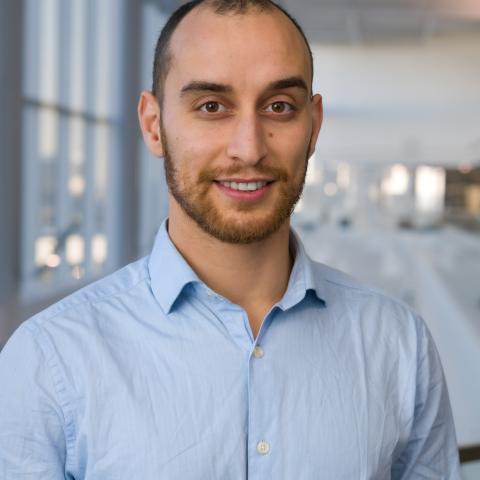
Javier Henriques-Gil
Javier has a mixed background in psychology (with a focus on neuropsychology), mechatronic engineering, and software development. His initial interest in human behavior, perception, and consciousness gradually pushed him towards a fascination for the brain itself and how we can interact with it. That fascination brought him to pursue training in biomedical engineering, electronics, and later on, software development. After spending several years working in an industrial research environment, he joined the Mind to Motion Lab as a Research Engineer, supporting the technical setup of various experiments. Looking back, the road he took to get here makes sense, with brain-machine interfacing sitting at the intersection of all that he felt drawn to in the past. By increasing our understanding of movement preparation in the brain, Javier hopes to contribute to novel assistive technologies that can restore motor function for those in need.

Avighnav Vasudevan
Avighnav is an undergraduate student attending Texas A&M University and majoring in Molecular and Cellular Neuroscience. He is a summer intern in the lab and is helping to develop a BCI demo application using an OPM-MEG. This application uses real-time neural signal processing and neural decoding to play a game using motor imagery. Though he is an aspiring neurosurgeon, he has a strong passion and interest in BCI research and aims to contribute to the development and awareness of neurotechnology.