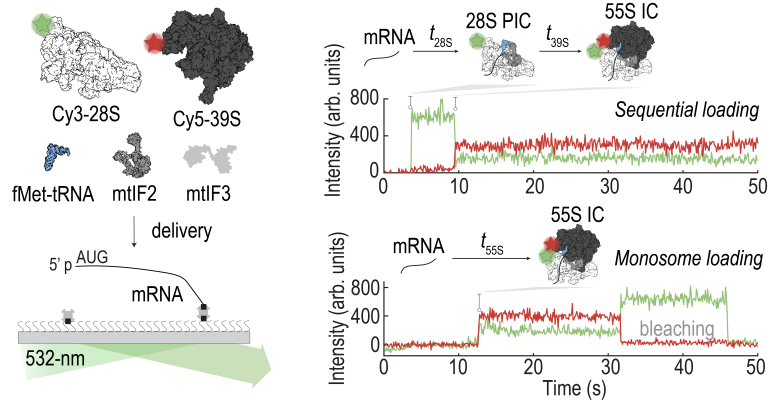
Mechanisms of human mitochondrial leaderless mRNA translation initiation
Shen S, Xu Y, Kober DL, Wang J. Nat. Commun. 2026, 17, 4887.
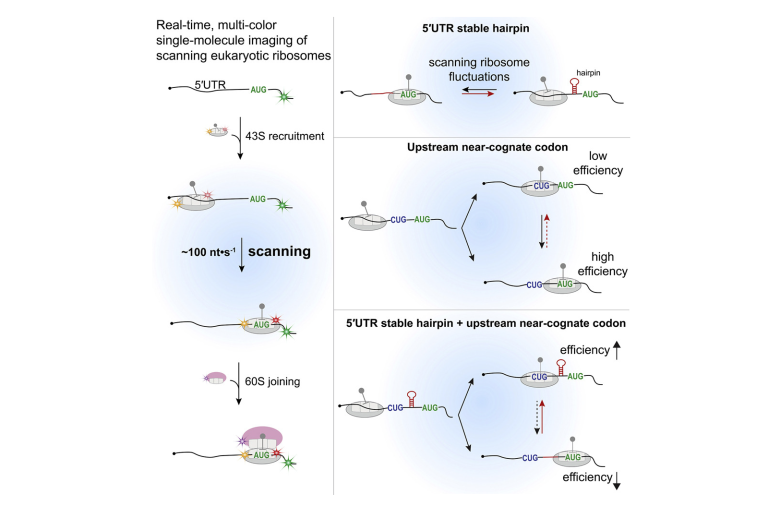
Rapid 40S scanning and its regulation by mRNA structure during eukaryotic translation initiation.
Wang J, Shin BS, Alvarado C, Kim JR, Bohlen J, Dever TE, Puglisi JD.
Cell 2022, 185, 4474-4487.e17.
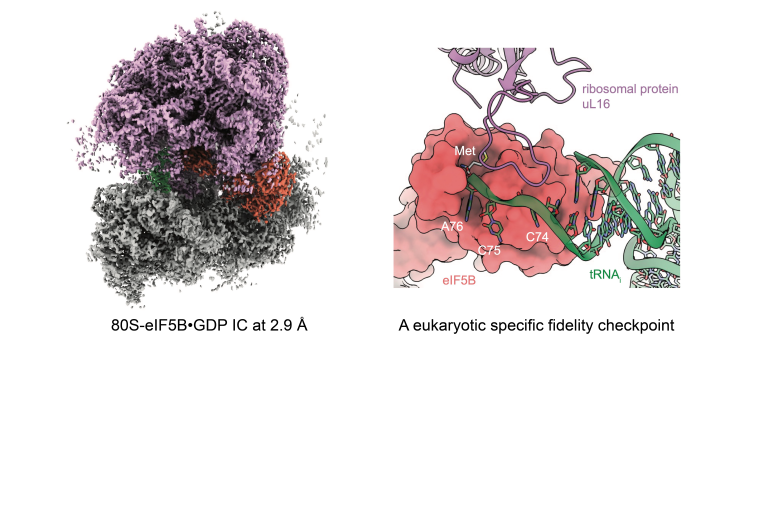
Structural basis for the transition from translation initiation to elongation by an 80S-eIF5B complex.
Wang J, Wang J, Shin BS, Kim JR, Dever TE, Puglisi JD. Fernández IS
Nat. Commun. 2020, 11, 5003.
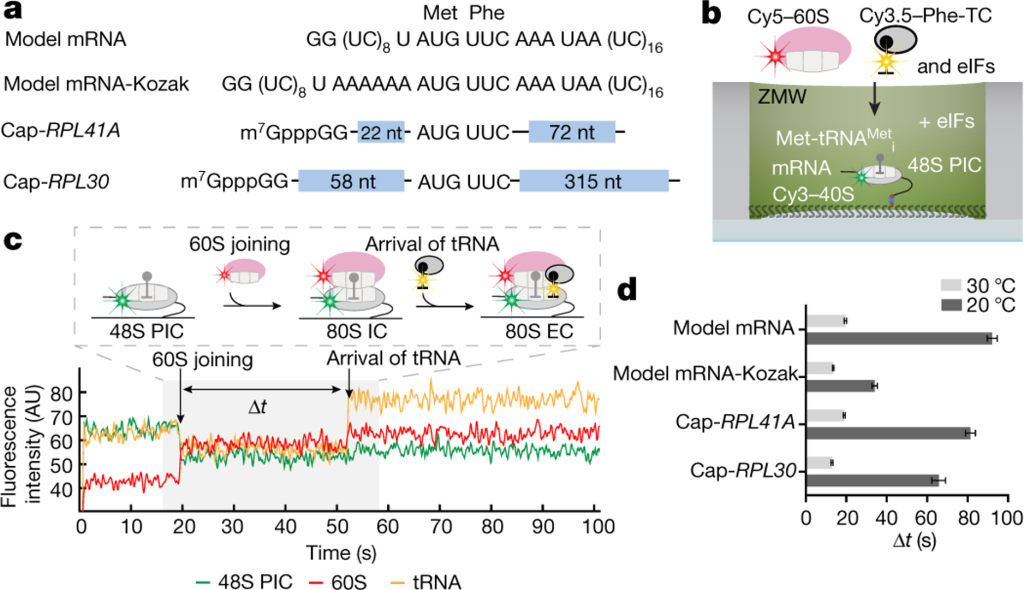
eIF5B gates the transition from translation initiation to elongation.
Wang J, Johnson AG, Lapointe CP, Choi J, Prabhakar A, Chen DH, Petrov AN, Puglisi JD.
Nature 2019, 573, 605-608.
All publications (# equal contribution):
25. Remodeling of mRNA by eIF4F in human translation initiation. Alvarado C, Lapointe CP, Wang J, Sokabe M, Grosely R, Dhepe AA, Stackhouse CI, Palo MZ, Mamot A, Jemielity J, Fraser CS, Puglisi JD. bioRxiv. 2026. doi: 10.64898/2026.06.19.733470
24. Mechanisms of human mitochondrial leaderless mRNA translation initiation. Shen S, Xu Y, Kober DL, Wang J. Nat. Commun. 2026, 17, 4887.
23. Real-time detection of human telomerase DNA synthesis by multiplexed single-molecule FRET. Hentschel J, Badstübner M, Choi J, Bagshaw CR, Lapointe CP, Wang J, Jansson LI, Puglisi JD, Stone MD. Biophys. J. 2023, 122, 3447-3457.
22. Dynamics of release factor recycling during translation termination in bacteria. Prabhakar A, Pavlov MY, Zhang J, Indrisiunaite G, Wang J, Lawson MR, Ehrenberg M, Puglisi JD. Nucleic Acids Res. 2023, 51, 5774-5790.
21. Rapid 40S scanning and its regulation by mRNA structure during eukaryotic translation initiation. Wang J, Shin BS, Alvarado C, Kim JR, Bohlen J, Dever TE, Puglisi JD. Cell 2022, 185, 4474-4487.e17.
20. eIF5B and eIF1A reorient initiator tRNA to allow ribosomal subunit joining. Lapointe CP, Grosely R, Sokabe M, Alvarado C, Wang J, Montabana E, Villa N, Shin BS, Dever TE, Fraser CS, Fernández IS, Puglisi JD. Nature 2022, 607, 185-190.
19. Plasticity and conditional essentiality of modification enzymes for domain V of Escherichia coli 23S ribosomal RNA. Liljeruhm J, Leppik M, Bao L, Truu T, Calvo-Noriega M, Freyer NS, Liiv A, Wang J, Blanco RC, Ero R, Remme J, Forster AC. RNA 2022, 28, 796-807.
18. Mechanisms that ensure speed and fidelity in eukaryotic translation termination. Lawson MR, Lessen LN, Wang J, Prabhakar A, Corsepius NC, Green R, Puglisi JD, Science 2021, 373, 876-882.
17. Dynamic competition between SARS-CoV-2 NSP1 and mRNA on the human ribosome inhibits translation initiation. Lapointe CP, Grosely R, Johnson AG, Wang J, Fernández IS, Puglisi JD. Proc. Natl. Acad. Sci. USA 2021, 118, e2017715118.
16. Structural basis for the transition from translation initiation to elongation by an 80S-eIF5B complex. Wang J, Wang J, Shin BS, Kim JR, Dever TE, Puglisi JD. Fernández IS, Nat. Commun. 2020, 11, 5003.
15. Dynamics of the context-specific translation arrest by chloramphenicol and linezolid. Choi J, Marks J, Zhang J, Chen DH, Wang J, Vázquez-Laslop N, Mankin AS, Puglisi JD. Nat. Chem. Biol. 2020, 16, 310-317.
14. eIF5B gates the transition from translation initiation to elongation. Wang J, Johnson AG, Lapointe CP, Choi J, Prabhakar A, Chen DH, Petrov AN, Puglisi JD. Nature 2019, 573, 605-608.
13. RACK1 on and off the ribosome. Johnson AG, Lapointe CP, Wang J, Corsepius NC, Choi J, Fuchs G, Puglisi JD. RNA 2019, 25, 881-895.
12. Kinetics of d-Amino Acid Incorporation in Translation. Liljeruhm J#, Wang J#, Kwiatkowski M, Sabari S, Forster AC. ACS Chem. Biol. 2019, 14, 204-213.
11. Ribosomal incorporation of unnatural amino acids: lessons and improvements from fast kinetics studies. Wang J, Forster AC. Curr. Opin. Chem. Biol. 2018, 46, 180-187.
10. How Messenger RNA and Nascent Chain Sequences Regulate Translation Elongation. Choi J, Grosely R, Prabhakar A, Lapointe CP, Wang J, Puglisi JD. Annu. Rev. Biochem. 2018, 87, 421-449.
9. 2'-O-methylation in mRNA disrupts tRNA decoding during translation elongation. Choi J, Indrisiunaite G, DeMirci H, Ieong KW, Wang J, Petrov A, Prabhakar A, Rechavi G, Dominissini D, He C, Ehrenberg M, Puglisi JD. Nat. Struct. Mol. Biol. 2018, 25, 208-216.
8. De novo design and synthesis of a 30-cistron translation-factor module. Shepherd TR, Du L, Liljeruhm J, Samudyata, Wang J, Sjödin MOD, Wetterhall M, Yomo T, Forster AC. Nucleic Acids Res. 2017, 45, 10895-10905.
7. Translational roles of the C75 2'OH in an in vitro tRNA transcript at the ribosomal A, P and E sites. Wang J, Forster AC. Sci. Rep. 2017, 7, 6709.
6. Dynamic basis of fidelity and speed in translation: Coordinated multistep mechanisms of elongation and termination. Prabhakar A, Choi J, Wang J, Petrov A, Puglisi JD. Protein Sci. 2017, 26, 1352-1362.
5. Ribosomal Peptide Syntheses from Activated Substrates Reveal Rate Limitation by an Unexpected Step at the Peptidyl Site. Wang J#, Kwiatkowski M#, Forster AC. J. Am. Chem. Soc. 2016, 138, 15587-15595.
4. Kinetics of tRNA(Pyl) -mediated amber suppression in E. coli translation reveals unexpected limiting steps and competing reactions. Wang J, Kwiatkowski M, Forster AC. Biotechnol. Bioeng. 2016, 113, 1552-1559.
3. Kinetics of Ribosome-Catalyzed Polymerization Using Artificial Aminoacyl-tRNA Substrates Clarifies Inefficiencies and Improvements. Wang J, Kwiatkowski M, Forster AC. ACS Chem. Biol. 2015, 10, 2187-2192.
2. Facile synthesis of N-acyl-aminoacyl-pCpA for preparation of mis-charged fully ribo tRNA. Kwiatkowski M, Wang J, Forster AC. Bioconjug. Chem. 2014, 25, 2086-2091.
1. Peptide formation by N-methyl amino acids in translation is hastened by higher pH and tRNA(Pro). Wang J, Kwiatkowski M, Pavlov MY, Ehrenberg M, Forster AC. ACS Chem. Biol. 2014, 9, 1303-1311.