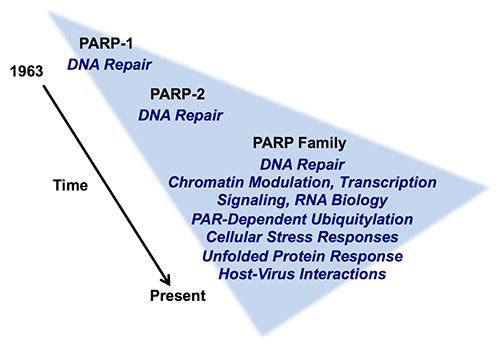
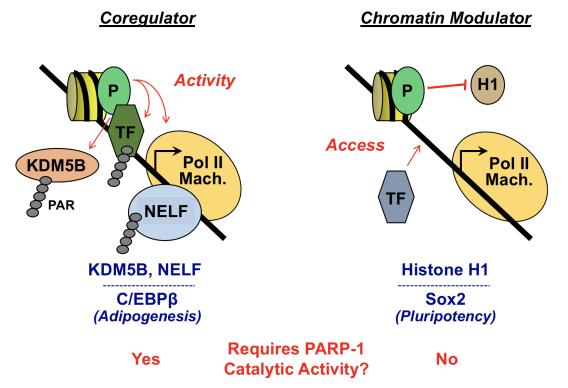
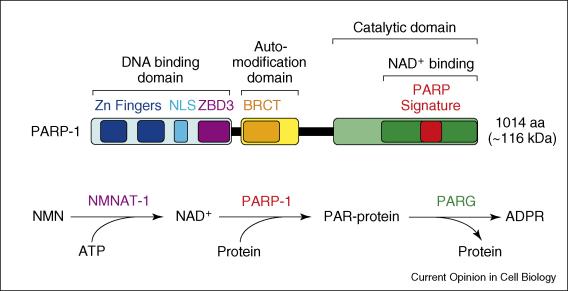
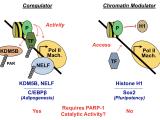
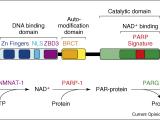
Studies of poly(ADP-ribosyl)ation by nuclear poly(ADP-ribose) polymerases (PARPs) enzymes were largely focused on their roles in DNA damage detection and repair in the 1960s through 1990s. In the early 2000s, the Kraus Lab was one of a small number that began to link PARP-1, an abundant nuclear PARP, to the regulation of chromatin structure and gene regulation. Using a range of biophysical, biochemical, and molecular approaches, the Kraus Lab found that PARP-1 plays key roles in the modulation of chromatin structure and gene expression in response to extracellular signals, such as those mediated by estrogens and TNFα. In addition, we have taken the lead in trying to understand how the synthesis of nuclear NAD+, the substrate for PARP-1, by the nuclear NAD+ synthase NMNAT-1 controls the gene regulatory functions of PARP-1 and downstream biological outcomes. These studies have linked cellular metabolic state, especially in the nucleus, to signal-regulated transcriptional outcomes.
Selected Publications
- Stokes MS, Kim YJ, Kim Y, Koul S, Chiu SP, Liu C, Dasovich M, Zuniga J, Nandu T, Huang D, Mathews TP, Solmonson A, Camacho CV, Kraus WL. NAD+ sensing by PARP7 regulates the C/EBPβ-dependent transcription program during adipogenesis. Cell Rep. 2026 Feb 24;45(2):116929. doi: 10.1016/j.celrep.2026.116929. Epub 2026 Jan 31. PMID: 41621069.
- Challa S, Nandu T, Kim HB, Gong X, Renshaw CW, Li WC, Tan X, Aljardali MW, Camacho CV, Chen J, Kraus WL. RACK1 MARylation regulates translation and stress granules in ovarian cancer cells. J Cell Biol. 2025 Feb 3;224(2):e202401101. doi: 10.1083/jcb.202401101. Epub 2025 Jan 6. PMID: 39760726.
- Chiu SP, Camacho CV, Kraus WL. Development and characterization of recombinant ADP-ribose binding reagents that allow simultaneous detection of mono and poly ADP-ribose. J Biol Chem. 2024 Sep;300(9):107609. doi: 10.1016/j.jbc.2024.107609. Epub 2024 Jul 27. PMID: 39074634.
- Huang D, Edwards AD, Gong X, Kraus WL. Functional Analysis of Histone ADP-Ribosylation In Vitro and in Cells. Methods Mol Biol. 2023;2609:157-192. doi: 10.1007/978-1-0716-2891-1_11. PMID: 36515836.
- Challa S, Whitaker AL, Kraus WL. Detecting Poly (ADP-Ribose) In Vitro and in Cells Using PAR Trackers. Methods Mol Biol. 2023;2609:75-90. doi: 10.1007/978-1-0716-2891-1_5. PMID: 36515830.
- Gupte R, Lin KY, Nandu T, Lea JS, Kraus WL. Combinatorial Treatment with PARP-1 Inhibitors and Cisplatin Attenuates Cervical Cancer Growth through Fos-Driven Changes in Gene Expression. Mol Cancer Res. 2022 Aug 5;20(8):1183-1192. doi: 10.1158/1541-7786.MCR-22-0111. PMID: 35503086.
- Jones A, Kraus WL. Multiomics analysis of the NAD+-PARP1 axis reveals a role for site-specific ADP-ribosylation in splicing in embryonic stem cells. Genes Dev. 2022 May 1;36(9-10):601-617. doi: 10.1101/gad.349335.121. Epub 2022 Jun 2. PMID: 35654456.
- Challa S, Ryu KW, Whitaker AL, Abshier JC, Camacho CV, Kraus WL. Development and characterization of new tools for detecting poly(ADP-ribose) in vitro and in vivo. Elife. 2022 Apr 27;11:e72464. doi: 10.7554/eLife.72464. PMID: 35476036.
- Huang D, Camacho CV, Martire S, Nagari A, Setlem R, Gong X, Edwards AD, Chiu SP, Banaszynski LA, Kraus WL. Oncohistone Mutations Occur at Functional Sites of Regulatory ADP-Ribosylation. Cancer Res. 2022 Jul 5;82(13):2361-2377. doi: 10.1158/0008-5472.CAN-22-0742. PMID: 35472077.
- Challa S, Khulpateea BR, Nandu T, Camacho CV, Ryu KW, Chen H, Peng Y, Lea JS, Kraus WL. Ribosome ADP-ribosylation inhibits translation and maintains proteostasis in cancers. Cell. 2021 Aug 19;184(17):4531-4546.e26. doi: 10.1016/j.cell.2021.07.005. Epub 2021 Jul 26. PMID: 34314702.
- Gupte R, Nandu T, Kraus WL. Nuclear ADP-ribosylation drives IFNγ-dependent STAT1α enhancer formation in macrophages. Nat Commun. 2021 Jun 24;12(1):3931. doi: 10.1038/s41467-021-24225-2. PMID: 34168143.
- Palavalli Parsons LH, Challa S, Gibson BA, Nandu T, Stokes MS, Huang D, Lea JS, Kraus WL. Identification of PARP-7 substrates reveals a role for MARylation in microtubule control in ovarian cancer cells. Elife. 2021 Jan 21;10:e60481. doi: 10.7554/eLife.60481. PMID: 33475085.
- Huang D, Camacho CV, Setlem R, Ryu KW, Parameswaran B, Gupta RK, Kraus WL. Functional Interplay between Histone H2B ADP-Ribosylation and Phosphorylation Controls Adipogenesis. Mol Cell. 2020 Sep 17;79(6):934-949.e14. doi: 10.1016/j.molcel.2020.08.002. Epub 2020 Aug 20. PMID: 32822587.
- Huang D, Kim DS, Kraus WL. Specific binding of snoRNAs to PARP-1 promotes NAD+-dependent catalytic activation. Biochemistry. 2020 Apr 28;59(16):1559-1564. doi: 10.1021/acs.biochem.0c00100. Epub 2020 Apr 17. PMID: 32293172.
- Kim DS, Camacho CV, Nagari A, Malladi VS, Challa S, Kraus WL. Activation of PARP-1 by snoRNAs controls ribosome biogenesis and cell growth via the RNA helicase DDX21. Mol Cell. 2019 Sep 19;75(6):1270-1285.e14. doi: 10.1016/j.molcel.2019.06.020. Epub 2019 Jul 24. PMID: 31351877.
- Ryu KW, Nandu T, Kim J, Challa S, DeBerardinis RJ, Kraus WL. Metabolic regulation of transcription through compartmentalized NAD(+) biosynthesis. Science. 2018 May 11;360(6389):eaan5780. doi: 10.1126/science.aan5780. PMID: 29748257.
- Luo X, Ryu KW, Kim DS, Nandu T, Medina CJ, Gupte R, Gibson BA, Soccio RE, Yu Y, Gupta RK, Kraus WL. PARP-1 controls the adipogenic transcription program by PARylating C/EPBβ and modulating its transcriptional activity. Mol Cell. 2017 Jan 19;65(2):260-271. doi: 10.1016/j.molcel.2016.11.015. PMID: 28107648.
- Liu Z, Kraus WL. Catalytic-independent functions of PARP-1 determine Sox2 pioneer activity at intractable genomic loci. Mol Cell. 2017 Feb 16;65(4):589-603.e9. doi: 10.1016/j.molcel.2017.01.017. PMID: 28212747.
- Gibson BA, Zhang Y, Jiang H, Hussey KM, Shrimp JH, Lin H, Schwede F, Yu Y, Kraus WL. Chemical genetic discovery of PARP targets reveals a role for PARP-1 in transcription elongation. Science. 2016 Jul 1;353(6294):45-50. doi: 10.1126/science.aaf7865. Epub 2016 Jun 2. PMID: 27256882.
- Krishnakumar R, Kraus WL. PARP-1 Regulates chromatin structure and transcription through a KDM5B-dependent Pathway. Mol Cell. 2010 Sep 10;39(5):736-49. doi: 10.1016/j.molcel.2010.08.014. PMID: 20832725.
- Gamble MJ, Frizzell KM, Yang C, Krishnakumar R, Kraus WL. The histone variant macroH2A1 marks repressed autosomal chromatin, but protects a subset of its target genes from silencing. Genes Dev. 2010 Jan 1;24(1):21-32. doi: 10.1101/gad.1876110. Epub 2009 Dec 15. PMID: 20008927.
- Krishnakumar R, Gamble MJ, Frizzell KM, Berrocal JG, Kininis M, Kraus WL. Reciprocal binding of PARP-1 and histone H1 at promoters specifies transcriptional outcomes. Science. 2008 Feb 8;319(5864):819-21. doi: 10.1126/science.1149250. PMID: 18258916.